Profonde Musique
March 31, 2026
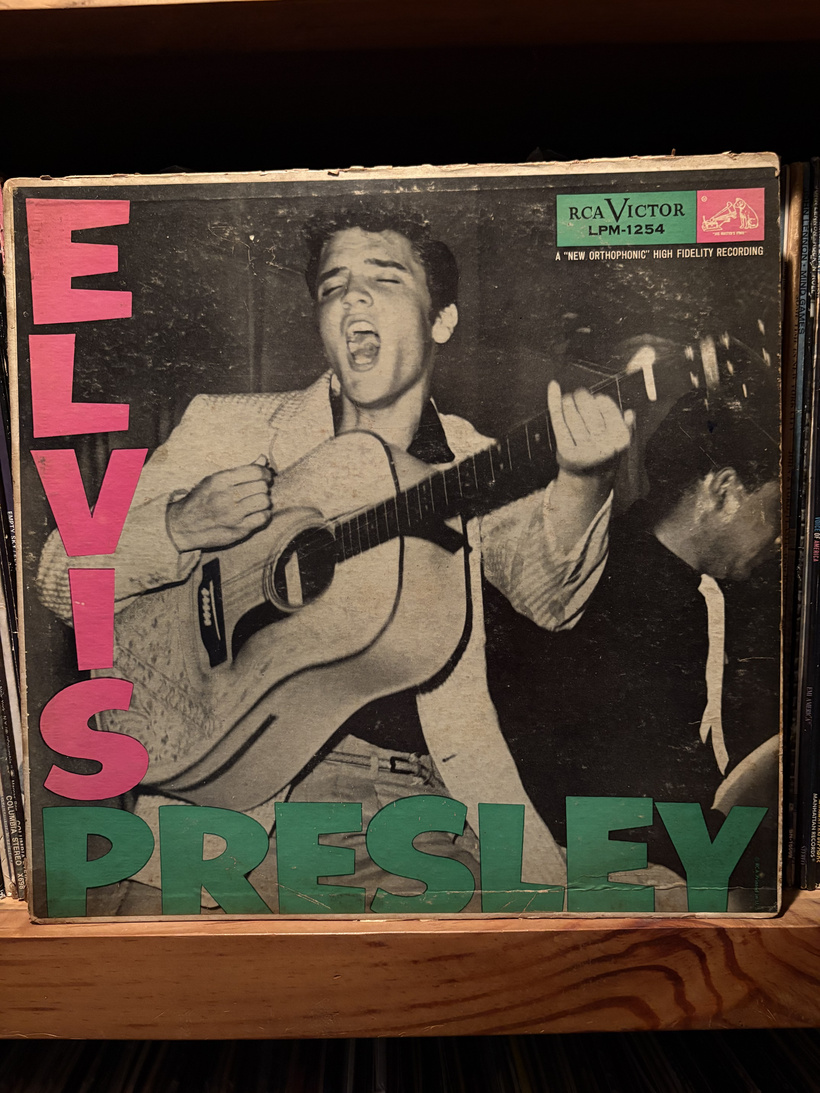
Seventy years ago, this spring (March 23, 1956), RCA Victor released the self-titled debut album from a twenty-one-year-old rockabilly crooner from Memphis Tennessee named Elvis Presley. Within the month it would reach the top of the U.S. charts, the first such feat for what certain deejays around the country were calling rock and roll. Elvis Presley Rock n’ Roll, as it was titled in the UK, subsequently topped the charts there. No one knows the first rock and roll record for sure. Some say “Rocket 88” by Jackie Brenston and his Delta Cats, which was Ike Turner’s Kings of Rhythm in disguise due to contractual obligations, the year before. Still other music historians point to earlier recordings that more than hint at a similar driving backbeat style in Sister Rosetta Tharpe’s “Strange Things Happening Every Day” (1944), Roy Brown’s “Good Rockin’ Tonight” (1947), a song Presley recorded as one of his first sides in 1954, and Goree Carter’s “Rock Awhile” (1949). But we do know for sure that Elvis Presley heralded this new music into the apex of popularity.
If anyone challenges the well-worn moniker King of Rock and Roll for Elvis, something I have done on more than one occasion, this is one factoid you can point to in his defense.
By the spring of 1956, Elvis was on a precipitous rise similar to Frank Sinatra’s a generation earlier – a stronghold on the fascination of the youth market, specifically women. Beyond his voice, however, Presley’s spastic movements on stage, a raw sexually charged combination of Beale Street shimmying and Baptist Church gyrations he picked up as a kid from the Black communities around Tupelo, Mississippi, set the course for his success on stages across the South. From the seismic release of his first single, “That’s All Right,” a sparkling boogie cover of bluesman, Authur Crudup’s 1946 hit, Presley came on as a naive hybrid sensation – a mish-mosh of country-blues-gospel-swing in an unfiltered package. Produced at Sun Records in Memphis by Sam Phillips, who spent years promoting Black acts like Howlin’ Wolf, Rufus Thomas, and B.B. King among others (Phillips cut “Rocket 88”), the song’s infectious rhythm, created by just Elvis on acoustic guitar, Bill Black on bass and Scottie Moore on guitar, shook the music industry to its core.
It was Phillips’s invention of the famed slap-back reverb sound that when combined with Elvis’s youthful yip-yelp phrasing, easing in and out of falsetto into a smooth timbre, backed ably with the groove of those instruments, which charted wholly new musical realms. Phillips would go onto record 24 revolutionary tracks at Sun with Elvis’s trio (and eventually foursome with D.J. Fontana on drums) between 1954 and 1955, ten of which he released on five two-sided singles. Then Elvis signed with the notorious Colonel Tom Parker, and when the big New York City labels came calling, the former carny huckster convinced RCA to pony up 40-grand (around 490-grand today) for Elvis’s Sun contract and back catalog by the end of ‘55.
Ten days into the new year, Elvis, along with Scotty, Bill and D.J., aka the Blue Moon Boys, convened at the Methodist Television, Radio and TV Studios in Nashville, Tennessee to begin recording their first RCA tracks. On day one, they completed arguably the most important and groundbreaking records of the 20th century, “Heartbreak Hotel.” With assistance from legendary Nashville session cats, guitarist Chet Atkins and pianist, Floyd Cramer, the single was awash in echo, a desperate attempt to recreate what Sam Phillips had wrought on all of Elvis’s best Sun recordings. This inadvertently gave “Heartbreak Hotel” an eerie moaning, almost mystical quality – Elvis sings as if facing his mortality in infinite loneliness. Seventeen days later it was on the radio, in stores, and being played across the Pond to thousands of teenagers like John Lennon, Paul McCartney, Mick Jagger and Keith Richards, who snapped into Beatles and Rolling Stones in its wake as if hit by a bolt of beatific lighting.
“Heartbreak Hotel,” penned by Nashville songwriters, Mae Boren Axton and Tommy Durden (Elvis was given credit – thanks, Colonel) from a suicide note published in the Miami Herald, obliterated culture, creating a firestorm across the universe and making Elvis Presley one of the most photographed, filmed, and written-about humans on the planet from that week forward.
By that point, Elvis Presley was pretty much in the can, as the Blue Moon Boys and a tireless Elvis cruised through seven tracks in the remaining weeks of January after cutting “Heartbreak Hotel.” Five more songs previously tracked by Phillips filled out the long player (sans the single), which was rushed out a mere two months later to a frantic public, who’d been quite recently introduced to Elvis’s swiveling hips, shaky knees, and flopping, long duck-tail greasy hair swaying atop his bopping head on this new-fangled invention called television. An entire generation waylaid by Chittlin’ Circuit furies pulsing through the vigorous limbs of this whirling dervish snarling and mumbling strange vibrations broadcast on variety shows like the Stage Show, Milton Berle Show, Steve Allen Show, and the Ed Sullivan Show.
My mom, Phyllis, then a plucky teen, watched the Ed Sullivan appearance and was hooked, explaining to me recently she’d had a dissimilar experience than the one written in history – Elvis as this alien creature set upon the conservative, sleepy black-and-white 1950s. In the Bronx that night, Elvis was the kind of beacon John Lennon once mused, “Before Elvis there was nothing.” She told me, “He was one of us. He made us feel like he was a part of our group, nothing old but entirely new.” Never one to speak in glowing terms at any age about anyone (sans Grace Kelly – the woman loved Princes Grace), Phyllis mused to me, “I played that record so much, my mother begged me to stop. And then my friends came over, and we played it a few times more. Drove my mom crazy.”
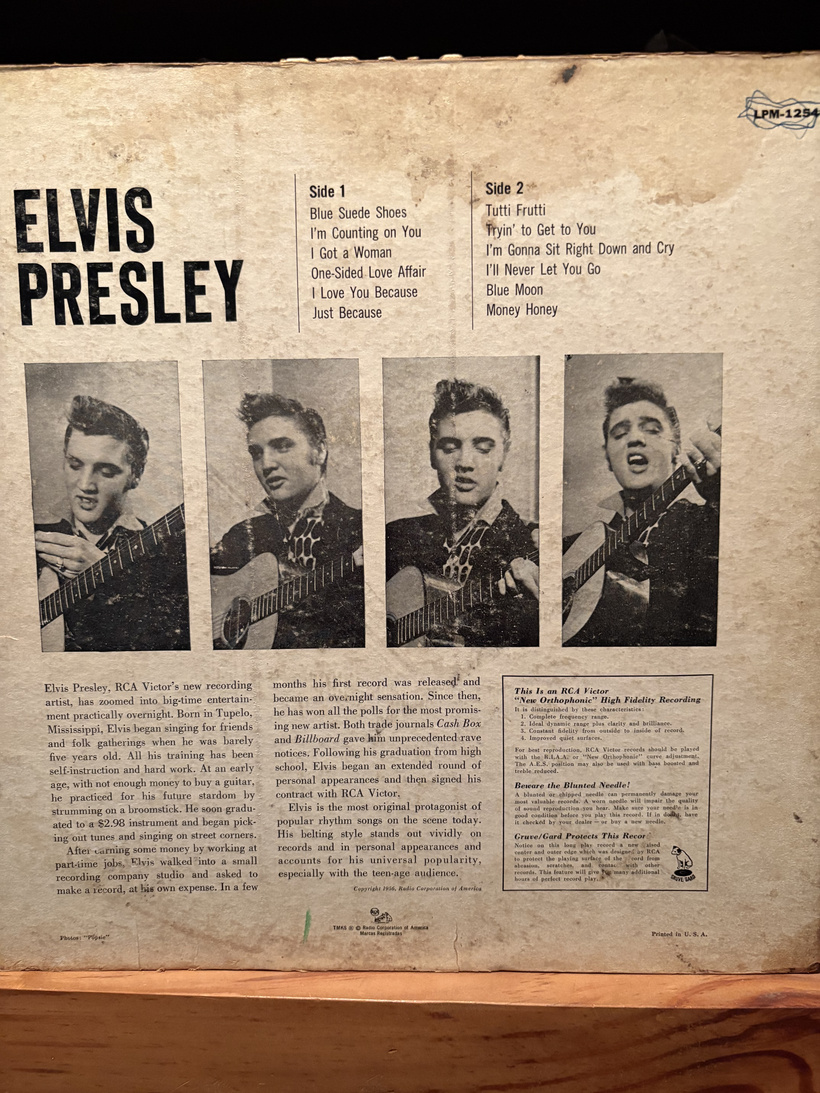
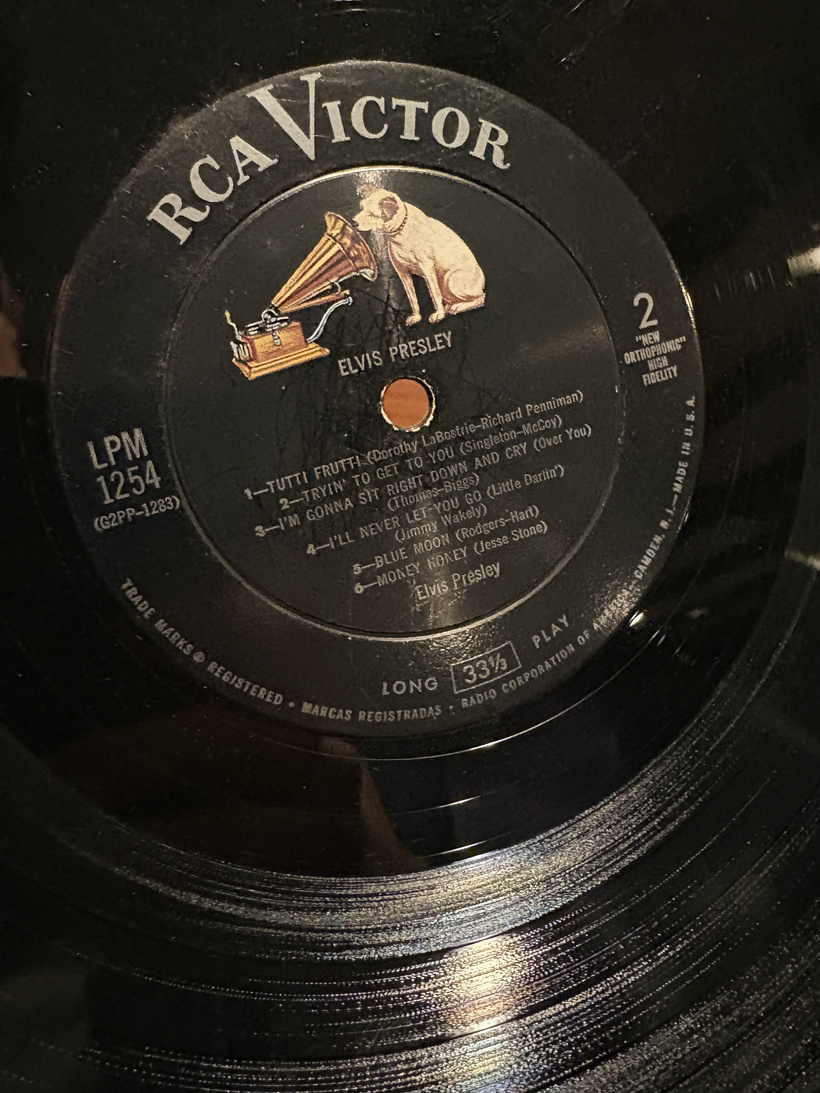
Photos of the copy of that very record, my mom’s beat-up 1956 original, is shared throughout this piece. She bequeathed it to me sometime in the 1970s and it remains in my collection, although I can’t play it. Man, did she ever play the shit out of that thing. No stylus of mine is going anywhere near it. But it is history – American, cultural, familial history. So, it remains tucked in there just the same. “I remember when I got it,” my mom told me. “I ran and grabbed it off the shelf. I was ready to fight anyone for it. You had to go to stores at specific times, or they would be sold out. It was rare to even see a copy.”
To fathom the light-speed in which Elvis Presley went from regional oddity to world-wide phenomenon can give you the bends. Elvis Presley was a sonic boom in every sense of the word. It helped create a chasm in generations separated by song and style and set the course for endless discussions on sex, race, gender, delinquency, culture – and invasion of the American psyche with a new lexicon for figuring cool.
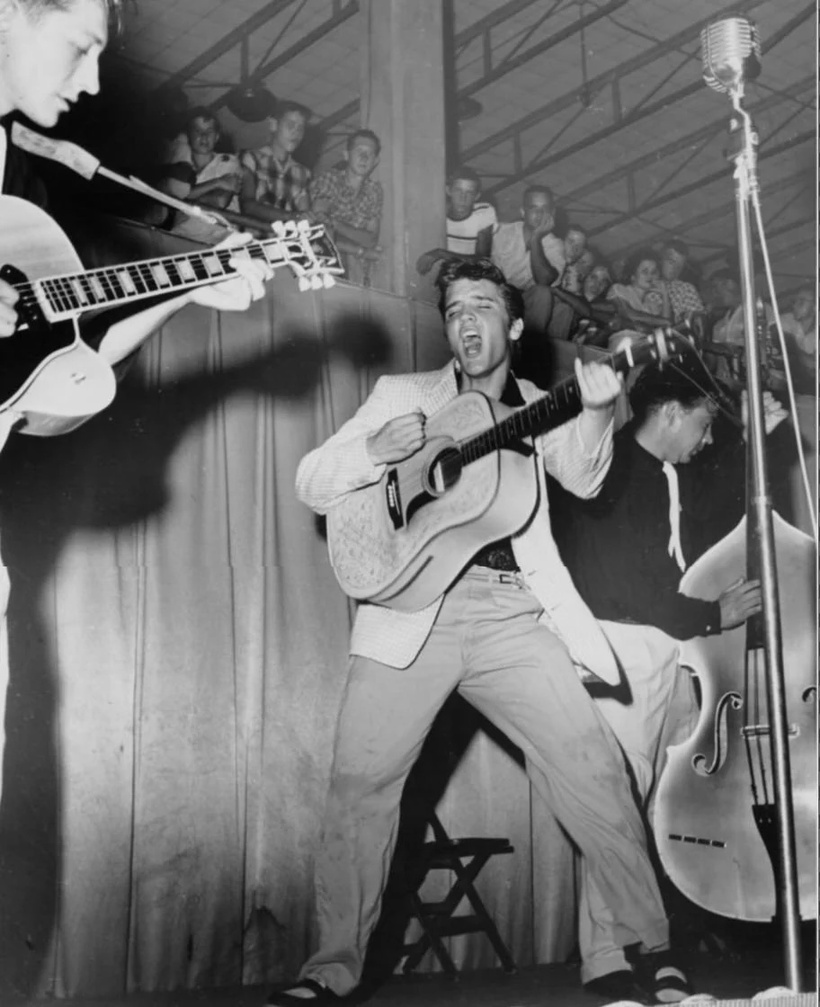
Its iconic cover, cropped from a photo of Presley performing in Tampa, Florida the previous summer, shows a man possessed, mouth agape in blissful song, his body a fluid kinetic wire untethered by mere gravity. There is a danger there in that he looks as if he does not care about anything other than the promise of that song.
The record inside lives up to its place in pop culture history. Enamored with three precursors to his rise, first Sun Records label-mate Carl Perkins, and the Black, gay, outrageously spirited Little Richards, Elvis kicked off each side with spectacular (“Blue Suede Shoes”) and serviceable, (Tutti Frutti”) renditions of their most famous work. He also made sure to include rhythm and blues giant, Ray Charles’s first hit, “I Got a Woman,” a reworked gospel cum raucous boogie-woogie, which Elvis had played at every single one of his shows up to then.
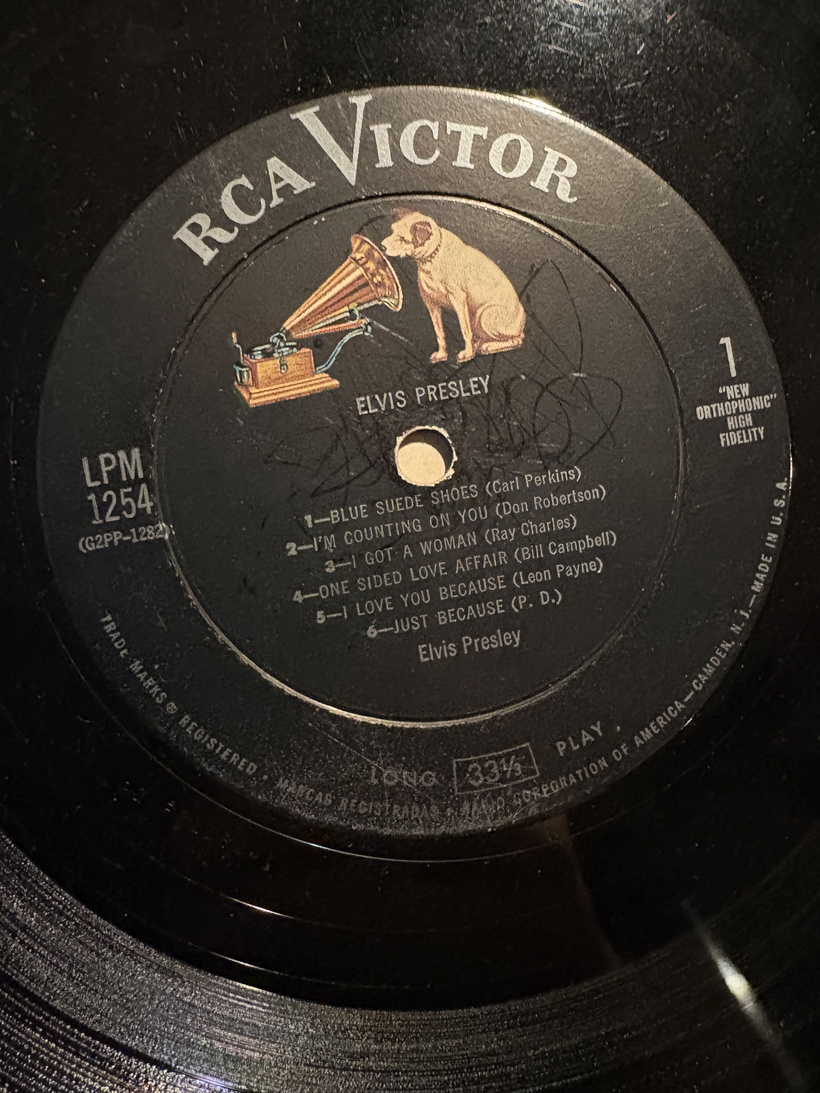
Other highlights of the album include a rockabilly Sun track, “Just Because,” wherein Elvis’s voice playfully bounces around the chugging rhythm effortlessly, “Tryin’ to Get to You,” a pulsing bluesy number he growls with blood-red passion, and a tender ballad, “I Love You Because” that shows off the unbridled range of emotions he would later perfect but with less honest solemnity.
Elvis Presley changed the look, sound and philosophy of this new thing called rock and roll. The album spent ten weeks at number one on the Billboard Top Pop Albums chart that year and became the genre’s first million-selling album. There would be more from rock and roll, of course, and you may have heard of those, but you could make a fair argument that none of them happen without this one. But that is a story for another column, so I’ll let Phyllis Campion have the final word: “When you played Elvis’s music, you had to play it loud.”
Recent Comments
Categories